March 26, 2026
Why Wi-SUN matters for large-scale smart infrastructure networks
As smart infrastructure deployments continue to grow, the demands on wireless communication are increasing as well. Applications such as smart metering, street lighting, EV charging, and industrial monitoring require more than a basic wireless link. They need connectivity that can cover large areas, remain reliable in dense environments, scale efficiently, and support long product lifecycles.
That is where Wi-SUN stands out.
Wi-SUN is designed for infrastructure-grade wireless communication and offers a strong foundation for large-scale IoT networks. By combining standards-based interoperability with secure, resilient mesh networking, it enables engineers to build connected systems that are ready for real-world deployment.
What is Wi-SUN?
Wi-SUN, short for Wireless Smart Utility Network, is an open wireless communication standard developed for field area networks. It is particularly well suited for applications that require long-range, low-power, and highly scalable connectivity.
Unlike point-to-point or short-range wireless technologies, Wi-SUN is built around mesh networking. This means devices in the network can communicate with each other and forward data across multiple paths. As a result, the network can cover a wider area and continue operating reliably even when conditions change.
This makes Wi-SUN a valuable option for smart infrastructure projects where uptime, interoperability, and future scalability are essential.
Why Wi-SUN is relevant for engineers
For engineers designing large-scale IoT systems, wireless performance is not only about data transfer. The network must also be able to handle device density, changing field conditions, and long operational lifetimes.
Wi-SUN addresses these requirements through several key advantages:
Mesh architecture for wider coverage and network resilience
Sub-GHz operation for strong range and penetration
IPv6-based communication for scalable addressing and integration
Interoperability through an open standard
Strong security for infrastructure and utility applications
Scalability for large and growing deployments
These characteristics make Wi-SUN well suited for projects where reliability matters just as much as connectivity.
How a Wi-SUN network works
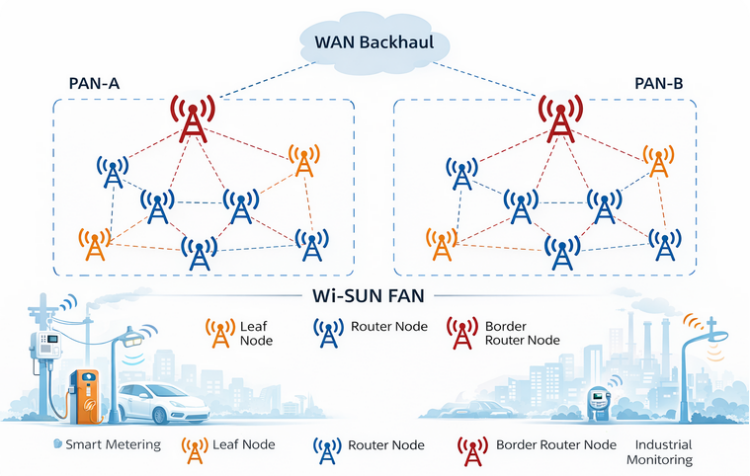
A Wi-SUN network typically consists of different node types, each with its own role in the overall architecture.
Leaf Node
A leaf node is an endpoint device in the network. It sends or receives data but does not route traffic for other devices. In practice, this could be a smart meter, sensor, EV charger, or monitoring device.
Router Node
A router node helps form the mesh backbone of the network. In addition to handling its own communication, it can forward data from other nodes. This extends the network’s reach and improves resilience by allowing multiple communication paths.
Border Router Node
The border router node connects the local Wi-SUN mesh network to the wider IP network. It acts as the gateway between field devices and backend systems such as cloud platforms, utility management systems, or enterprise infrastructure.
WAN Backhaul
The WAN backhaul is the external connection from the border router to the broader network. This could be Ethernet, fiber, or cellular connectivity. It is important to note that the WAN backhaul is not part of the Wi-SUN FAN specification itself, but rather the external path that links the Wi-SUN network to outside systems.

This image shows how a Wi-SUN network works.
Leaf nodes act as endpoints, router nodes relay data across the mesh, and the border router connects the local network to the wider IP infrastructure through the WAN backhaul.
This architecture enables scalable, resilient wireless communication for smart infrastructure applications.
Where Wi-SUN is used
Wi-SUN is increasingly relevant across a range of infrastructure-focused markets. Typical applications include:
Smart metering
Smart street lighting
EV charging infrastructure
Industrial monitoring
Smart city systems
Utility and energy networks
Agriculture
In all of these environments, the value of Wi-SUN lies in its ability to support reliable communication across large areas with many connected devices.
How TOP-electronics supports Wi-SUN designs
At TOP-electronics, we support customers with wireless solutions designed for demanding infrastructure applications. For teams exploring Wi-SUN, this means access not only to the right module technology, but also to technical guidance that helps match the solution to real design requirements.
From connectivity selection to application support, our team helps engineers evaluate whether Wi-SUN is the right fit for their next development.
Conclusion
Not every wireless network is built for infrastructure.
For applications where coverage, resilience, interoperability, and long-term scalability are critical, Wi-SUN offers a compelling approach. Its mesh architecture, open standard, and infrastructure-focused design make it a strong technology choice for modern smart infrastructure deployments.
As connected systems continue to expand, Wi-SUN is becoming an increasingly important option for engineers building the next generation of smart energy, smart city, and industrial IoT solutions.
High-performance MCU Wi-SUN module
Could Wi-SUN be the right fit for your next infrastructure design?
The TOP-team is ready to support you!