September 11, 2026
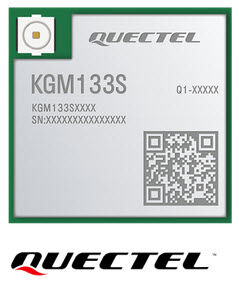
Quectel’s KGM133S and KGM133S-P bring multiple short-range wireless technologies together in a single compact MCU module, giving developers more flexibility when designing connected products for smart building, lighting, home automation and industrial IoT.
The modules support Matter 1.4, Thread 1.4, Zigbee 3.0 and Bluetooth Low Energy 6.0, as well as Thread, Zigbee and BLE mesh networking. At the heart of the module is an Arm Cortex-M33 processor running at up to 78 MHz, combined with 256 KB SRAM and flash options up to 3.5 MB.
For RF performance, Quectel specifies sensitivity down to -105 dBm and optional transmit power up to +19.5 dBm. The operating temperature range of -40°C to +105°C also makes the platform suitable for applications outside the comfortable world of consumer electronics.
The KGM133S measures only 12.5 × 13.2 × 2.2 mm, while the KGM133S-P measures 16.6 × 13.2 × 2.2 mm and integrates a PCB antenna interface. Quectel also offers an optional Secure Vault security implementation. For engineers, the main advantage is straightforward: one module can support several important IoT ecosystems without requiring a separate radio solution for each protocol.
Quectel’s KGM133S series combines Matter 1.4, Thread 1.4, Zigbee 3.0 and Bluetooth LE 6.0 support in one compact 2.4 GHz MCU module. Based on an Arm Cortex-M33 running up to 78 MHz, the modules offer 256 KB SRAM, up to 3.5 MB Flash, mesh networking, flexible antenna options and an operating range from -40 to +105 °C. The result is a flexible hardware platform for smart-home, building automation, lighting and other low-power connected devices.
Wireless protocol selection can become surprisingly complicated in an IoT design.
A smart-home product may need Bluetooth LE for commissioning, Thread for an IP-based mesh network, Matter for interoperability or Zigbee for compatibility with an existing installed base. Selecting one protocol too early can restrict the product architecture or create the need for additional radio hardware later in the design.
Quectel addresses this with the KGM133S and KGM133S-P, compact MCU modules supporting Matter 1.4, Thread 1.4, Zigbee 3.0 and Bluetooth LE 6.0 from a single module platform. They also support Thread, Zigbee and Bluetooth mesh networking.
For us at TOP-electronics, that protocol flexibility is one of the main reasons these modules are interesting. It allows an OEM to build around a common hardware platform while retaining more freedom in the final connectivity architecture.
That can be particularly useful when different customers, markets or product variants require different wireless ecosystems.
Although the module supports four major standards, they should not simply be viewed as four interchangeable wireless protocols.
Matter provides the application-layer interoperability framework intended to make devices work across different smart-home ecosystems.
Thread provides an IPv6-based, low-power mesh network and is commonly used as the network transport underneath Matter devices.
Zigbee remains widely deployed in lighting, building automation and established smart-home installations.
Bluetooth LE is particularly useful for direct device communication, configuration and commissioning and can also be used in Bluetooth Mesh applications.
This distinction matters when defining the system architecture. A module that supports these technologies gives the development team options, but it does not remove the need to determine which protocol combination best fits the application.
And, importantly, support for multiple protocols should not automatically be interpreted as unrestricted simultaneous operation of every protocol stack. The required concurrency, memory usage and radio behaviour should always be checked against the final firmware architecture.
The KGM133S series is built around an Arm Cortex-M33 processor running at up to 78 MHz.
Quectel specifies:
| Specification | KGM133S series |
|---|---|
| Processor | Arm Cortex-M33 |
| CPU frequency | Up to 78 MHz |
| SRAM | 256 KB |
| Flash | 1.5 MB, 2.5 MB or 3.5 MB options |
| Wireless band | 2.4 GHz |
| Matter | 1.4 |
| Thread | 1.4 |
| Zigbee | 3.0 |
| Bluetooth | BLE 6.0 |
| Mesh | Thread, Zigbee and Bluetooth Mesh |
| Operating temperature | -40 to +105 °C |
The available Flash configurations are particularly relevant for multi-protocol products, where protocol stacks, application firmware, security functions and OTA-update requirements can quickly increase memory demand.
The main difference between the KGM133S and KGM133S-P is the module size and antenna implementation.
The KGM133S measures only 12.5 × 13.2 × 2.2 mm, while the KGM133S-P measures 16.6 × 13.2 × 2.2 mm. Both use an LGA form factor.
The KGM133S provides options for an IPEX Gen 4 RF coaxial connector or pin antenna interface, giving designers more freedom to use an external antenna.
The KGM133S-P adds an integrated PCB antenna option.
This means the selection is not simply about saving a few millimetres of PCB area.
An external antenna can provide more flexibility when the module is located inside a difficult enclosure or when antenna placement needs to be optimized independently of the main PCB. An integrated PCB antenna can simplify the BOM and mechanical design when the available PCB and enclosure layout allows it.
Antenna choice remains part of the RF design, not a checkbox at the end of the schematic.
Quectel specifies receiver sensitivity down to -105 dBm and optional transmit power up to +19.5 dBm for the KGM133S series.
Together with support for mesh networking, this makes the platform relevant for applications where many devices must communicate across a building or installation.
Typical examples include:
Mesh capability is particularly useful where a single point-to-point link does not provide sufficient coverage or where the number of devices makes a star topology less attractive.
The exact network behaviour will of course depend on the selected protocol, topology, RF environment and application firmware.
A wireless module still has to communicate with sensors, actuators and other electronics in the end product.
The KGM133S series normally provides 21 GPIOs, with Quectel indicating that up to 26 can be available in special configurations. These pins can be used for interfaces including I²C, USART, SPI and I²S.
That allows the Cortex-M33 to perform more than radio duties alone.
Depending on the application architecture, the module can interface directly with sensors, user-interface electronics, control devices or other peripherals without automatically requiring an additional host MCU.
For cost-sensitive or space-constrained IoT products, removing one processor from the BOM is often more interesting than adding another impressive acronym to the datasheet.
Connecting products to a home, building or cloud infrastructure also increases the importance of device security.
Quectel therefore offers Secure Vault as an enhanced security option for the KGM133S series.
For a real product design, we would recommend looking beyond the statement that a module is "secure". The complete architecture should include questions such as:
Those questions become increasingly important for products that may remain installed for ten years or more.
The main technical advantage of the KGM133S family is not that it simply puts several protocol names on one datasheet.
It gives developers a common MCU and RF platform from which different connected-product architectures can be developed.
For example, the same hardware concept could potentially be used for a Matter-over-Thread device in one product and a Zigbee implementation in another, while Bluetooth LE can support commissioning or direct interaction.
That can reduce hardware variation across a product family and provide more flexibility when connectivity requirements change during development.
It can also make migration easier when a customer has an existing Zigbee installation today but is evaluating Matter and Thread for a future generation.
At TOP-electronics, we see the KGM133S series as particularly interesting for designs where low-power wireless connectivity, mesh networking and ecosystem flexibility need to come together.
Typical applications include smart lighting, building controls, connected appliances, HVAC controls, sensors, access systems and smart-home devices.
But we would not select the module purely because it supports four protocols.
The real selection process starts with the application:
Which ecosystems must the product support? How many nodes are expected? Is mesh required? How will the device be commissioned? What are the memory requirements? Which antenna concept fits the enclosure? And what security and lifecycle requirements apply?
Those decisions determine whether the KGM133S, KGM133S-P or another wireless architecture is the best technical fit.
TOP-electronics can support engineering teams in evaluating the Quectel KGM133S and KGM133S-P against the complete application requirements, from protocol selection and antenna concept to interfaces, memory and integration.
If you are developing a Matter, Thread, Zigbee or Bluetooth LE product and want to determine which architecture makes sense before fixing the hardware design, contact our technical team.
Protocols: Matter 1.4, Thread 1.4, Zigbee 3.0, Bluetooth LE 6.0
Processor: Arm Cortex-M33, up to 78 MHz
Memory: 256 KB SRAM, up to 3.5 MB Flash
Networking: Thread, Zigbee and Bluetooth Mesh
RF: sensitivity down to -105 dBm, optional TX power up to +19.5 dBm
Interfaces: GPIO with I²C, USART, SPI, I²S and others
Temperature: -40 to +105 °C
KGM133S: 12.5 × 13.2 × 2.2 mm
KGM133S-P: 16.6 × 13.2 × 2.2 mm
Security: Secure Vault option