September 11, 2026
As computing moves from individual servers toward complete rack-scale systems, connectivity requirements are changing as well. Power shelves, cooling equipment, sensors, accelerators and service processors increasingly need their own management and control paths. MaxLinear addresses this with RackCommander, a portfolio combining connectivity, monitoring, control and power-management devices for AI, cloud, enterprise and edge infrastructure.
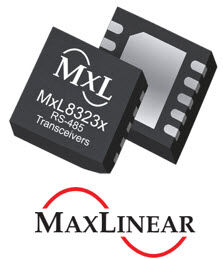
MaxLinear’s MxL8323x family provides half-duplex RS-485/RS-422 communication with data-rate options from 500 kbps to 50 Mbps. The devices operate from a 3.0 to 5.5 V supply, provide a separate 1.65 to 5.5 V logic interface, support up to 256 nodes, and operate from -40 to +125 °C. Protection includes ±4 kV EFT, ±8 kV contact ESD and ±15 kV air-gap ESD, while a ±15 V operational common-mode range helps accommodate ground-potential differences in industrial networks.
RS-485 and RS-422 remain widely used in industrial systems because differential signaling provides a practical way to communicate over wired networks in electrically demanding environments.
But selecting the transceiver is not simply a matter of putting "RS-485" on the schematic.
Modern industrial designs may combine low-voltage processors with 3.3 V or 5 V bus circuitry, require dozens or hundreds of nodes, operate close to motors and switching electronics, or need considerably higher communication speeds than earlier control networks.
MaxLinear developed the MxL8323x family around these requirements, with different speed options, wide logic-level compatibility and additional electrical protection.
The MxL8323x family currently consists of five half-duplex RS-485/RS-422 transceivers:
This gives engineers several performance points within the same product family rather than forcing every node to use a 50 Mbps transceiver.
That matters because maximum speed is not always the design target. For a slower industrial bus, controlling edge rate can help reduce unwanted high-frequency content and EMI. The MxL83235 and MxL83236 therefore provide selectable slew-rate control that can limit operation to 500 kbps when required.
A useful feature of the MxL8323x architecture is the separate VL logic supply.
The transceivers themselves support a supply voltage from 3.0 to 5.5 V, while their logic interface can operate from 1.65 to 5.5 V. This allows the digital side of the device to interface directly with lower-voltage MCUs, processors and SoCs without automatically requiring additional level-shifting circuitry.
For us at TOP-electronics, this is one of the more relevant system-level specifications.
A 50 Mbps headline is easy to notice. Avoiding another level translator, additional PCB area and another potential integration issue is often more useful when the board actually has to be built.
The receivers have an input impedance of at least 96 kΩ, corresponding to a 1/8 unit load. MaxLinear specifies support for up to 256 nodes on an RS-485 multidrop network.
This makes the family suitable for systems where many controllers, sensors, drives or other nodes share the same physical bus.
The theoretical node count should, of course, not be treated as the only network-design parameter. Cable topology, termination, stub length, data rate and signal integrity still determine whether a real 256-node installation behaves properly.
RS-485 is robust, not magical.
Industrial communication links can be exposed to transients generated by switching loads, motors, relays, long cables and differences in local ground potential.
MaxLinear specifies the following protection for the MxL8323x devices:
±4 kV EFT according to IEC 61000-4-4, ±8 kV contact ESD according to IEC 61000-4-2, ±15 kV air-gap ESD according to IEC 61000-4-2, and ±15 kV Human Body Model ESD.
The family also provides an extended ±15 V operational common-mode range. This is particularly relevant where two nodes do not sit at exactly the same ground potential, something that becomes very real once a cable leaves the development bench and runs through an industrial installation.
The receivers incorporate enhanced fail-safe circuitry.
MaxLinear specifies a logic-high receiver output when the inputs are open, shorted or idle. The drivers also include short-circuit protection and thermal shutdown, and maintain a high-impedance state when powered off.
This behaviour is important in multidrop networks because the receiver should enter a known state rather than produce unpredictable output when no active driver is controlling the bus.
For designs requiring more control around insertion, shutdown and signal edges, the 10-pin MxL83235 and MxL83236 add several functions.
These devices provide hot-swap circuitry on the DE and RE pins, intended to prevent bus glitches during power-up or live insertion. They also include a low-power shutdown mode, specified by MaxLinear at 1 µA supply current, together with the selectable slew-rate function mentioned earlier.
This makes the choice between family members more than a simple speed selection.
The 8-pin MxL83232/33/34 provide the core high-performance transceiver functions in a conventional package footprint, while the 10-pin MxL83235/36 add additional bus-management functionality.
With a 5 V supply, MaxLinear specifies a differential output exceeding 2.1 V for PROFIBUS compatibility.
That does not mean the IC alone turns a design into a complete certified PROFIBUS implementation, but it is an important electrical specification for engineers considering the devices in that type of industrial network.
All five MxL8323x devices are specified for an operating temperature range from -40 to +125 °C.
MaxLinear identifies target applications including industrial control systems, high-performance motor drives, industrial and single-board computers, smart-grid systems, building security and automation, process control and HVAC equipment.
The motor-control use case is particularly relevant because it combines several of the challenges the family addresses: electrical noise, ground offsets, temperature, high communication speed and a need for predictable data transfer.
At TOP-electronics, we would not start the selection process with the question: “Which one has the highest data rate?”
We would first look at the actual bus.
Required throughput, cable length, topology, node count, termination, MCU I/O voltage, EMI constraints, expected transients, package size and whether hot-swap behaviour is required all influence which device is the better choice.
For example, 50 Mbps may be useful for a short, high-performance industrial connection, but a longer network running at a lower rate can benefit from controlled signal edges. Similarly, a 1.8 V processor makes the separate VL supply particularly useful, while a live-insertion architecture may push the selection towards the MxL83235 or MxL83236.
That is the difference between selecting a transceiver from one number in a parametric table and selecting it for the system it actually has to survive.
Protocols: RS-485 and RS-422
Configuration: Half duplex
Family data rates: 500 kbps, 20 Mbps and 50 Mbps
Main supply: 3.0 to 5.5 V
Logic interface: 1.65 to 5.5 V
Bus loading: 1/8 unit load, up to 256 nodes
Operational common-mode range: ±15 V
Temperature: -40 to +125 °C
EFT: ±4 kV, IEC 61000-4-4
ESD contact: ±8 kV, IEC 61000-4-2
ESD air gap: ±15 kV, IEC 61000-4-2
HBM ESD: ±15 kV.
TOP-electronics can support engineering teams in selecting the right MaxLinear MxL8323x transceiver for the electrical and system requirements of the application.
That includes looking beyond baud rate to the processor voltage, bus architecture, node count, EMC environment, package requirements and protection strategy.
For industrial connectivity, the communication protocol may be well established. The challenge is making sure it continues to work when the machine, cable and electrical noise are added.
Back