August 17, 2026
Summary
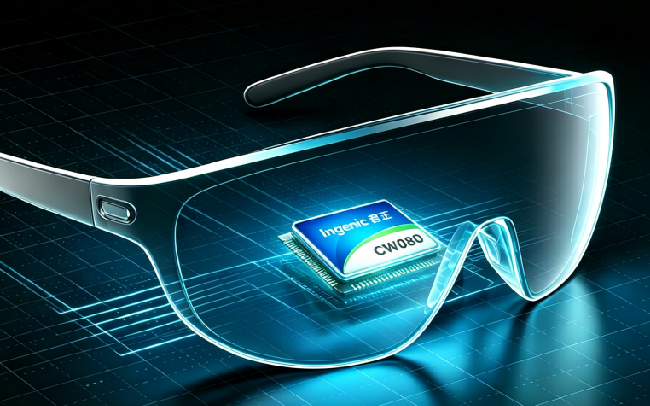
Ingenic has introduced the CW080, a flagship image signal processor for compact wearable-vision devices such as AI glasses, camera-enabled earbuds and smartwatches. With integrated memory, 4K encoding, electronic image stabilization and a 1 TOPS NPU, the CW080 addresses one of the key engineering challenges in wearable AI: adding vision while keeping power, size, latency and thermal behaviour under control.
Adding a camera to an AI wearable is only the visible part of the design challenge. The real engineering work starts when the product has to capture images, process data, respond quickly and still remain small, cool and power efficient.
That is where Ingenic’s new CW080 becomes interesting.
The CW080 is positioned as a flagship ISP for compact wearable-vision applications, including AI glasses, camera-enabled earbuds, smartwatches and other small edge devices. Instead of relying on a single large application processor for every task, the CW080 can handle image capture, 4K video encoding and electronic image stabilization, while Bluetooth, voice and system control can remain on a separate MCU.
For engineers, this architecture is relevant because it supports a more efficient division of responsibilities inside the product. Camera processing can be handled close to the image sensor, while the rest of the system can be optimized separately for connectivity, user interaction, voice processing or low-power standby operation.
According to Ingenic, the CW080 supports 12 MP imaging, H.265 encoding up to 4K, a 1 TOPS NPU and integrated 128 MB DDR3 in a compact 7 × 11 mm package. The device is also specified for low-power use cases, including 1 mW standby for the CW080SNP, 350 mW for 1080p30 recording with EIS and 9 mW average power for always-on sensing.
Response time is another important part of the design story. Ingenic specifies sub-300 ms capture latency and sub-200 ms video start-up, both relevant for applications where the camera must react quickly without keeping the full system active all the time.
In wearable designs, these figures matter. A camera subsystem does not only consume board space. It affects battery size, heat, enclosure design, firmware architecture and the user experience. Nobody wants AI glasses that behave like a small toaster with lenses.
For many embedded-vision applications, resolution is only one part of the selection process. Engineers also need to look at:
where image processing takes place,
how much memory is required,
how quickly the system can wake up and capture,
how much power is used in standby and active modes,
how video encoding affects thermal behaviour,
how the ISP connects to the rest of the system,
and how the architecture scales from prototype to production.
The CW080 makes this discussion more concrete. It gives engineers a way to separate the camera and vision pipeline from the rest of the system architecture, which can help reduce design complexity in compact AI-enabled products.
The CW080 fits into a broader trend in Edge AI. More intelligence is moving closer to the sensor, especially in systems where latency, privacy, bandwidth and power consumption are critical.
For wearable vision, this means that the camera is no longer just an input device. It becomes part of the decision-making chain. The system must sense, process and respond locally, often within a tight energy budget.
This is also why dedicated processing architectures are becoming more important. Not every design needs a large application processor for every function. In many cases, a more distributed architecture, using the right processor for the right task, can deliver a more efficient and reliable product.
In addition to CW080, the CW020 is also about to be released. With ultra-small size and extreme low power consumption, it takes TWS true wireless Bluetooth earphones as the typical application scenario, endowing earphones with environmental perception, environment recognition and AI interaction capabilities.
At TOP-electronics, we support engineers with technologies for Edge AI, sensing, camera modules and embedded processing. We will also show an Ingenic camera demo during both WoTS 2026 and embedded world North America.
Visitors can use the demo to discuss camera integration, local processing, power consumption, latency and application requirements with our team.
Not able to visit one of the exhibitions? Contact TOP-electronics directly. We will be happy to share more information and help you explore the right solution for your design.
Back