March 27, 2026
Healthcare is becoming more connected, more data-driven, and more distributed. From bedside systems and laboratory equipment to remote monitoring and wearable devices, medical electronics are increasingly expected to combine sensing accuracy, secure connectivity, low power consumption, and long-term reliability in one design. TOP-electronics supports this shift with a broad technology portfolio for medical and lab applications, including displays, power supplies, connectors, embedded computing solutions, analog solutions, sensors, and wireless technologies.
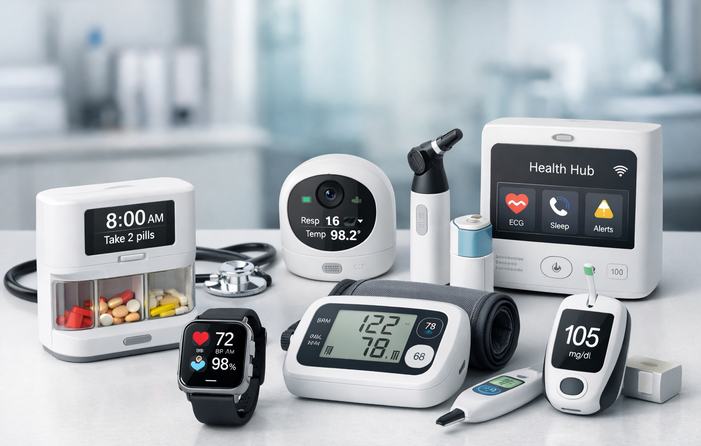
This evolution is often described as the Internet of Medical Things, or IoMT: a connected ecosystem of sensors, embedded processing, wireless modules, and system interfaces that helps turn medical devices into intelligent, responsive platforms.
In practice, that means more real-time data, more efficient workflows, and more opportunities to support care both inside and outside traditional clinical environments. This is especially relevant in applications where power consumption, noise, radiation, and maintenance requirements place strict demands on the electronics used.A smart medical IoT device is not defined by connectivity alone. The real challenge is system-level performance. Medical and healthcare-related designs must capture relevant data reliably, process it efficiently, and transfer it securely, while fitting within strict constraints around size, power budget, uptime, and product lifetime.
At TOP-electronics, we support medical and healthcare-related developments with a broad portfolio for applications including scanning devices, connected medication management systems, bedside consoles, laboratory systems, test and measurement equipment, and other healthcare electronics.
For engineers, this translates into several key design priorities:
At the heart of every connected medical device is a combination of electronic building blocks that determines how the system performs in the field. Sensor quality influences measurement integrity. Embedded compute affects responsiveness and local processing capability. Connectivity defines how reliably data moves between device, gateway, and application layer. Power conversion shapes battery life, efficiency, and thermal behavior. In medical design, these elements must be considered as part of one integrated system.
At TOP-electronics, we combine a broad technology portfolio with application knowledge, design support, and professional logistic services, with offices across EMEA, the USA, Hong Kong, and Shenzhen. We support customers throughout development and production, helping engineers select complementary technologies and build reliable solutions with confidence.
Our portfolio supports a broad range of medical and laboratory electronics applications, combining technologies for sensing, wireless connectivity, embedded computing, power conversion, and display integration.
That means engineers can work with a partner that supports more than component sourcing alone. TOP-electronics works directly with engineers from pre-development onward, supported by technical sales, Field Application Engineers, and customer-support teams. For medical and healthcare-related programs, that combination can help reduce design risk, simplify solution selection, and improve continuity from concept to production.
Reliable sensing is a fundamental requirement in connected healthcare electronics. TOP-electronics’ portfolio includes solutions across the Sensors category, with technologies such as temperature and humidity sensors, motion and orientation sensors, ToF sensors, thermal cameras. This makes the portfolio relevant for a wide range of medical and healthcare-related designs where precise detection, environmental awareness, or motion tracking is required.
In smart medical devices, sensing quality directly affects usability and trust in the final application. Whether the system is designed to monitor patient movement, environmental conditions, thermal characteristics, or equipment status, the front-end sensing choice has consequences for stability, integration effort, and long-term field performance.
Connected healthcare depends on reliable communication. TOP-electronics’ Wireless and IoT portfolio includes Bluetooth, LoRa, Wi-Fi, cellular generations from 2G to 5G, AIoT modules, GNSS, gateways, routers, and related technologies. That breadth is important because healthcare applications vary widely in bandwidth, latency, mobility, infrastructure, and power requirements.
For some designs, Bluetooth Low Energy is a strong fit for short-range, power-conscious data exchange. For others, LPWA or cellular solutions may make more sense for remote assets or distributed monitoring.
Medical IoT devices increasingly depend on local intelligence to pre-process data, manage sensors, support user interfaces, and reduce unnecessary communication load. TOP-electronics supports these needs through its Displays and Embedded Computing and Components portfolios, as well as embedded wireless SoC options.
We offer a combination of displays, touch technology, SoMs, MCUs, low-power SoCs, and embedded processing platforms to help engineers develop complete and efficient connected systems.
This is valuable in applications where responsiveness, integration, and power efficiency all matter. Local processing can help reduce latency, simplify user interaction, and improve overall system behavior in connected healthcare products.
Power architecture remains one of the most important building blocks in compact medical electronics. TOP-electronics’ Power Conversion category is explicitly positioned for sectors including medical, with products designed to manage voltages and currents efficiently in compact, adaptable designs. That is especially relevant for battery-powered devices, always-on systems, portable instrumentation, and electronics where thermal constraints affect reliability and comfort.
Beyond conversion itself, TOP-electronics also offers Thermal Management solutions and broader system-level support. This matters because medical device performance is not only about nominal power efficiency; it is also about maintaining reliability and stable operation over long deployment periods.
Designing smart medical IoT devices requires more than individual components. It requires a partner that understands how sensing, connectivity, embedded processing, power, and logistics come together in a reliable product. This is where TOP-electronics makes the difference: by supporting customers both technically and logistically, locally and globally, from the first design phase through production and after-sales.
As healthcare electronics continue to evolve, stronger outcomes will depend on stronger engineering decisions. And those decisions are easier to make with access to proven technology, application knowledge, and practical design support.
Smarter healthcare starts with stronger design choices and a technology-driven partner that supports you both technically and logistically.
We love to connect… engineers and technology
Back