August 18, 2026
Summary
Quectel’s smart-module portfolio with Android 16 support shows how wireless modules are evolving beyond connectivity. By combining cellular communication, application processing and rich multimedia interfaces in one platform, smart modules can simplify connected product development, but they also make operating-system support, lifecycle planning and integration strategy part of the hardware decision.
Selecting a wireless module used to be mainly about network support, RF performance, certification and data rate.
That is changing.
With smart modules, the module is no longer only responsible for communication. It can also provide application processing, graphics support, camera and display interfaces, audio functionality, positioning and software-platform support. In other words, the module becomes part of the complete system architecture.
Quectel’s smart-module portfolio with Android 16 support is a good example of this shift.
Quectel’s SH602FA is an LTE Cat 4 smart module with Wi-Fi and Bluetooth, Android 16 support and a compact LCC form factor. The module is designed for applications that require cellular connectivity together with multimedia and peripheral functions, such as smart POS, industrial handheld equipment, smart safety devices, vending machines, logistics cabinets, smart home products and audio/video recorders.
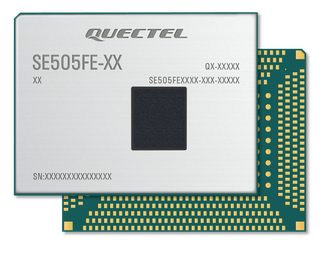
For 5G applications, Quectel’s SE505FE adds 5G sub-6 GHz connectivity, Wi-Fi and Bluetooth, Android 16 support, camera capability and multimedia interfaces. The module targets industrial and consumer applications that need higher data rates and richer multimedia functionality.
The SG520B series extends the smart-module concept further with 5G sub-6 GHz, Wi-Fi 6E, Bluetooth and support for Android 13, 14, 15 and 16 depending on the variant. It combines wireless connectivity with support for camera, display, touch, UART, USB, I2C and I2S interfaces.
The technical question is not simply whether a module supports Android 16.
The more important question is whether the smart-module architecture fits the complete product design.
Using a smart module can reduce the need for a separate application processor, modem and multiple interface components. This can simplify hardware development and shorten integration time. However, it also means that operating-system support, BSP maintenance, peripheral drivers, security updates and long-term module availability become part of the selection process.
That is where the design trade-off becomes interesting.
A smart module can be a strong choice when a product needs cellular connectivity, display control, camera input, local processing and multimedia functions in a compact architecture. But engineers still need to evaluate thermal behaviour, antenna integration, software support, regional variants, certification requirements and lifecycle planning.
Smart modules are especially relevant for products such as:
industrial handheld devices,
smart POS terminals,
connected safety systems,
multimedia terminals,
smart gateways,
vending machines,
logistics cabinets,
routers and CPE devices,
smart home products,
smart wearables,
camera-enabled connected devices.
In these applications, the module is not just a communication component. It can become the central platform that connects the user interface, network, sensors, cameras and application software.
At TOP-electronics, we support engineers with wireless modules, smart modules, antennas and system-level integration. Together with Quectel, we help customers evaluate the right module architecture for their application, taking into account connectivity, interfaces, software support, RF design, lifecycle and certification.
Are you developing a connected product where cellular connectivity, Android support, display control, camera input or local processing must work together?
Contact TOP-electronics to discuss the right Quectel smart-module solution for your design.
Back