August 13, 2026
A storage device can have impressive peak throughput and still become a bottleneck.
That is one of the challenges in modern AI infrastructure. As AI workloads become more dynamic, concurrent and unpredictable, storage is no longer evaluated only by maximum bandwidth or headline IOPS. The behaviour of the storage system under real workload pressure becomes just as important.
This is especially relevant for agentic AI, retrieval-augmented generation, vector databases and KV-cache related workloads. These applications do not behave like simple sequential storage workloads. Multiple processes may read context, update KV-cache, retrieve embeddings, generate new data and access previous states at the same time.
That creates changing I/O patterns, mixed read/write behaviour and resource contention.
In traditional architectures, SSDs were primarily seen as a place to store data. In AI infrastructure, that role is changing.
As inference architectures scale, not all data can remain close to the processor in HBM or system DRAM. High-performance NAND storage is increasingly becoming part of a larger AI memory hierarchy, supporting data staging, context extension, model updates and access to large datasets.
In this environment, predictable latency can become just as important as maximum throughput.
The key question for engineers is not only how fast an SSD can perform in ideal benchmark conditions. It is whether the storage system can maintain consistent behaviour when reads, writes, KV-cache updates and embedding retrieval happen simultaneously.
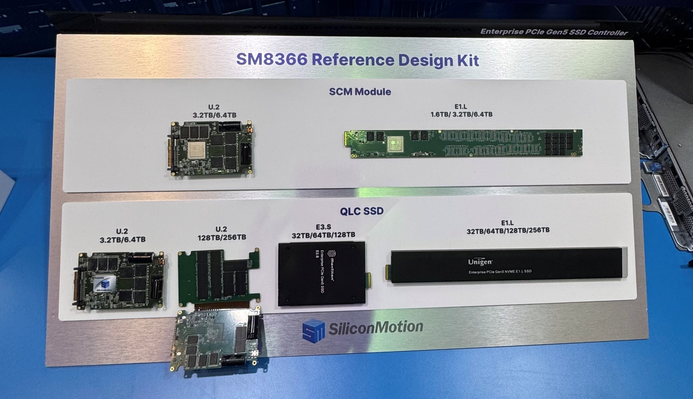
Our partner Silicon Motion addresses this challenge with its next-generation PerformaShape technology for enterprise SSD controllers, including the SM8366 PCIe 5.0 and SM8466 PCIe 6.0 platforms.
PerformaShape is designed to optimize SSD performance based on user-defined quality-of-service requirements. By shaping workload behaviour and improving isolation between concurrent workloads, the technology helps enterprise SSDs deliver more predictable performance under demanding AI and data center workloads.
For AI infrastructure, that predictability matters.
A fast SSD can still limit system performance if latency becomes unstable under mixed workloads. When GPUs, CPUs and accelerators wait for data, storage behaviour directly affects overall system efficiency.
For R&D engineers, the evaluation of enterprise storage is moving beyond peak throughput.
Important design considerations include:
latency under mixed workloads;
p99 and p99.9 latency behaviour;
simultaneous read/write performance;
workload isolation;
quality of service under changing I/O patterns;
endurance under sustained AI workloads;
power and thermal behaviour;
system-level impact on GPU or accelerator utilization.
This makes the SSD controller an important part of the complete AI system architecture.
It is no longer only about where data is stored, but how reliably and predictably that data can be accessed when the system is under pressure.
At TOP-electronics, we help engineers look beyond headline specifications and evaluate how storage, memory, data movement and system architecture work together in real applications.
Because in AI infrastructure, faster storage is useful.
Predictable storage may be critical.
Are you working on AI infrastructure, enterprise storage, edge computing or data-intensive embedded systems?
Back