September 11, 2026
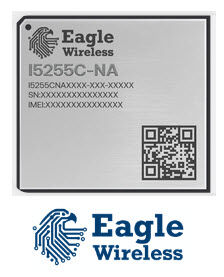
The Eagle Wireless I5255C-GL is a 3GPP Release 17 5G RedCap module for industrial and commercial IoT applications. It supports 5G Sub-6 GHz SA and LTE Cat 4, with theoretical peak rates up to 223 Mbps downlink and 123 Mbps uplink. With optional multi-constellation GNSS and interfaces including USB 2.0, PCIe 2.0, UART, PCM, SGMII and SPI, it gives OEMs a practical route to 5G where full eMBB performance would be unnecessary.
When selecting cellular connectivity for an industrial design, the obvious question is often whether the application needs 4G or 5G.
In practice, that question is too simple.
A remote monitoring system, industrial gateway or connected machine may require more bandwidth and lower latency than LPWA technologies can provide, but still have no need for the throughput, RF complexity and system overhead associated with a conventional high-performance 5G modem.
That is exactly the gap 5G Reduced Capability, or RedCap, was developed to address.
Introduced in 3GPP Release 17, RedCap reduces the capability requirements of a 5G device while keeping it within the 5G NR architecture. In FR1, RedCap devices are limited to a maximum channel bandwidth of 20 MHz and use a less complex radio architecture than conventional 5G NR devices. The result is a category positioned between low-data-rate IoT connectivity and full eMBB 5G.
For us at TOP-electronics, this is what makes RedCap interesting: it is not simply a slower version of 5G. It is a different engineering trade-off.
The Eagle Wireless I5255C-GL is designed specifically for this RedCap application space.
It is an industrial-grade 5G Sub-6 GHz module based on 3GPP Release 17 RedCap technology and supports both 5G Standalone operation and LTE Cat 4. Eagle specifies theoretical peak data rates of:
Those figures put the module well above traditional LTE-M and NB-IoT performance, while still avoiding the design envelope of a full high-bandwidth 5G implementation.
That makes the I5255C-GL particularly relevant for applications such as industrial gateways, routers, remote monitoring platforms, connected equipment and other systems where a few hundred megabits per second is more than sufficient.
One of the practical strengths of the I5255C-GL is that Eagle combines 5G Sub-6 GHz SA operation with LTE Cat 4.
This matters when designing equipment for real deployments rather than a lab bench.
RedCap availability is still dependent on operator and network rollout. Supporting LTE Cat 4 alongside RedCap gives OEMs additional flexibility where 5G RedCap coverage is not yet available or where the same product must operate across different network generations.
Eagle also states that the module is backward compatible with Release 15 and Release 16 networks and partially compatible with its I42x 4G module family.
For long-life industrial products, this migration aspect can be just as important as peak throughput.
Looking only at the 223 Mbps figure misses part of the story.
Because RedCap operates within the 5G architecture, it can support features associated with 5G networks while using a reduced-complexity device implementation. Eagle lists support for 5G LAN, URLLC and network slicing for the I5255C-GL.
From a system-design perspective, that creates interesting possibilities.
A machine builder may not require multi-gigabit communication, but may still want predictable connectivity, segmented network resources or integration into a private or managed 5G infrastructure.
Of course, these functions depend not only on the module but also on the operator, network architecture and subscription. A checkbox in a module specification does not automatically turn an application into a deterministic 5G system, sadly engineering remains slightly more complicated than that.
For TOP-electronics, cellular module selection never stops at the radio specification. The module still has to fit into the actual hardware architecture.
The I5255C-GL provides a useful set of interfaces including:
Eagle also provides USB driver support for Windows 10/11, Linux and Android.
The presence of SGMII is particularly interesting for gateway and networking applications, where the cellular module must connect efficiently into an Ethernet-oriented host architecture.
PCIe 2.0 also gives designers another integration route and can be used in system architectures where Wi-Fi or Bluetooth connectivity is added alongside cellular connectivity.
These interfaces are not glamorous specifications, but in a real design they often determine whether integration takes two weeks or two months.
For connected equipment, telematics and mobile industrial systems, cellular connectivity is often only half of the requirement.
Positioning may be required as well.
The I5255C-GL therefore supports optional Qualcomm IZat Gen 9VT positioning technology with multiple satellite constellations:
Integrating GNSS into the cellular module can simplify the hardware architecture and reduce the need for a separate positioning subsystem.
For applications such as asset monitoring, mobile industrial equipment or remote infrastructure, that can reduce PCB complexity while providing both connectivity and location from the same module platform.
We would look seriously at RedCap when an application falls between two familiar extremes.
On one side are low-power cellular technologies such as LTE-M and NB-IoT. These are excellent for sensors, meters and devices that exchange relatively small quantities of data.
On the other side is conventional 5G eMBB, designed for much higher throughput and more demanding broadband applications.
The Eagle Wireless I5255C-GL fits the space in between.
Typical examples include industrial gateways, machine connectivity, video or image transfer at moderate data rates, remote service platforms, routers, security systems and commercial telematics. Eagle also positions its RedCap portfolio across several of these application areas.
The important design question is therefore not: “Do we need 5G?” It is: “What level of 5G capability does this application actually need?”
If the application does not benefit from multi-gigabit throughput, a RedCap solution can be a much more logical starting point.
Before selecting the I5255C-GL, we would normally review the complete application rather than the module in isolation.
That means looking at the required regional bands and operator support, expected RedCap availability, LTE fallback strategy, antenna architecture, GNSS requirements, host interface, software environment, certification route and expected product lifetime.
Power architecture and thermal design should also be considered early. Even though RedCap reduces complexity compared with full 5G, it is still a cellular radio subsystem and should be treated accordingly in the PCB, power and RF design.
This is where TOP-electronics adds value.
We can help engineering teams determine whether 5G RedCap, LTE Cat 4, LTE-M or another cellular technology is the best fit for the actual application, and then support the integration of the selected module into the complete system.
If you are developing an industrial gateway, connected machine, router or remote monitoring platform and are evaluating whether 5G RedCap makes sense, talk to us.
We can help review the connectivity requirements, interfaces, GNSS needs and migration path before the module choice becomes fixed in the design.
Product: Eagle Wireless I5255C-GL
Technology: 5G RedCap, 3GPP Release 17
5G mode: Sub-6 GHz SA
LTE: Cat 4
Peak data rate: 223 Mbps DL / 123 Mbps UL
GNSS: Optional multi-constellation Qualcomm IZat Gen 9VT
Interfaces: USB 2.0, PCIe 2.0, PCM, UART, SGMII, SPI
Back